Sunny Argentina
Hidden little cafes are all over Buenos Aires
Buenos Aires, the capital city of Argentina, is a fascinating place. Bustling yet laid-back, it is huge and still somehow feels like a village. People don’t seem rushed the way they do in many big cities. Compared to many South Americans we’ve met so far, Argentines seem the most laid back and sincere. This gentle pace makes the city feel immediately comfortable and welcoming.
Buenos Aires officially has 48 barrios (neighborhoods), each with its own distinct personality, especially in the expansive historic center. Here, most buildings are just one or two stories high, lined up neatly along a grid of streets where almost every road is one-way, even many of the broader six-lane avenues. The result is chaotic, stop-and-go traffic that can turn a short Uber ride into a surprisingly long hour from one barrio to another. We based ourselves in Villa Crespo, a charming, slightly bohemian historic neighborhood with a Spanish feel, right next to the larger, fancier, more touristy, yet still very appealing, Palermo.
After a hectic time in Peru, hopping ever higher toward the Incan capital of Cusco, we finally slowed down here where we could relax and later celebrate Christmas. Jyl had brought work with her, so during the first week Randy and I explored many areas by foot around our home base. We had rented a modern loft apartment in its first year on Airbnb, with cool air conditioning in the sweltering summer heat, spacious inside an old brick factory building that now houses a mix of offices and apartments. Spending two weeks in one place felt like the perfect way to get to know Buenos Aires—slowly, selectively, and on our own terms.
Colorful painted facades line the streets and create a lively streetscape - playful, expressive and full of personality rather than polish all over town.
Randy and I visited the famous Teatro Colón, whose construction was begun by an Italian architect and whose interior showcases generous amounts of Italian marble.
Inside lobby of the Teatro Colón, the opera house feels grand, ornate, and unmistakably European.
We ate most lunches and dinners out, using every meal as an excuse to explore Argentine cuisine. We shopped groceries for various breakfasts (Randy makes fantastic breakfast) and later for our Christmas and holiday meals.
Empanadas filled with meat, seafood, mushrooms, or fruits are available as snack food everywhere
On every packaged food are government warnings: excessive sugar, excessive fat, excessive saturated fat, and excessive calories (like in this little coffee cookie)
Grocery shopping took its time as Porteños (people from Buenos Aires) rely on small specialty shops and corner markets; supermarkets are mainly for non-perishable groceries. Every few blocks, there seemed to be a butcher, a vegetable and fruit store, an empanada shop, a bakery, or another small shop selling a special something. You had to learn where to get what. No English here, so yes, sometimes a bit challenging.
El Ateneo, a magnificent bookshop housed in a former theater
Of course, Argentina is known for its meat, or so we believed. However, it is actually the asado, a slow-cooked barbecue often featuring ribs and other cuts cooked over an open fire, that they truly treasure. We anticipated juicy steaks, common in the USA, quick and tasty, and were always, always disappointed.
Two reasons for that: Argentines don’t like spicy food and only lightly salt their meats. Big difference! Secondly, while the meat is excellent for long, slow cooking, it is not ideal for quick grilling, which tends to arrive at the table very chewy.
In general, it appeared to us that food in Argentina is almost exclusively produced locally, with hardly any American or Asian food items available. It was nearly impossible to find feta cheese, for example.
Animals have more space and time to roam, which means more developed muscle and, in turn, tougher meat—better for the animals, though. Because of this, I started avoiding ordering beef. As it is summer, the fruits here are very delicious and tasty and jams are made exclusively from local fresh fruits.
Who would have thought that behind this innocuous door would be a beautiful, green and most delicious garden restaurant?
Just the entrance area of this rather big place called “Chui”
Luckily for us, the closest restaurant to our loft, Chui, just a two-minute walk away, was a vegetarian/vegan place hidden away. If you didn’t know it was there, you could easily miss it, yet the food was absolutely delicious (Mmmm - watermelon-gazpacho!). We later discovered it had a Michelin Distinction, which suddenly made its popularity make sense. Once we knew that, we made a habit of arriving a bit earlier than the locals for both lunch and dinner, since typical lunchtime runs from about 1 to 3 p.m., and dinner crowds start arriving around 9 p.m.
Randy toured the barrio of La Boca, the colorful, lively old port district where several of Argentina’s most famous figures grew up like the artist Benito Quinquela Martín and the famous football legend Diego Maradona.
La Boca is known for its colorful atmosphere
Randy had the best home-made empanada in this literal hole-in-the-wall in La Boca
This mural depicts the "Desaparecidos” (disappeared) during the 70’s “Dirty War” against activists, students, and journalists
Palacio Barolo, also created by an Italian like with Teatro Colón, is an office building designed as an architectural homage to Dante’s Inferno. Its floors are divided into three symbolic sections—hell, purgatory, and heaven—
— so that as you climb, you quite literally ascend to Dante’s heaven, which was a lighthouse top where you could see a 360 degree panorama of the city.
The famous La Recoleta Cemetery is an amazing historic site with multitudes of ornate mausoleums and crypts
Many tombs have been designed during the Art Deco period
Eva Peron’s body was eventually returned home and interred here after being kidnapped and removed from Argentina
The passionate Tango originated at the end of the 19th century here in Buenos Aires
In our second week, we went for an overnight trip to the Iguazú Falls in the north. I’m usually not particularly excited about waterfalls, but when we went on our first trail, you pass some smaller cascades and some lakes and then, just around the corner, you see this massive arch of enormous amounts of water, thundering deep down in white unknowns, it was just breath-taking, even for me. It is something so powerful that it is hard to describe.
Breathtaking and thundering
The next day, Jyl took a boat ride right up to the base of the falls and came back grinning, soaked, and absolutely thrilled. Randy crossed over to the Brazilian side for a different vantage, where he saw the falls spread out in full panorama, emerald moss hanging from exposed cliffs between a network of 275 waterfalls comprising Iguazú Falls. The whole trip was so worth it!
Christmas rolled around, and funnily enough, there was very little decoration or holiday music anywhere in Buenos Aires. I suppose it is more privately celebrated, but then again, it is the middle of summer here, so no Christmas trees and therefore not many decorations, which I had hoped to buy. Ultimately, it wasn’t a problem. We had bought fabric-decorated balls in Cusco, Peru, which Randy hung from a light fixture, and we made that our improvised tree. We had already agreed not to exchange gifts (bringing—and carrying back—no!), so on Christmas Eve we revived an old family tradition: a puzzle competition! Randy and I traveled earlier one day to a totally different barrio, found a store selling only jigsaw puzzles, and bought three identical 500-piece puzzles of the same image. No surprise, Jyl finished first by a wide margin, and Randy and I followed almost an hour later, neck on neck, with only three minutes between us.
On Christmas Day, after baking some cookies, we had booked two escape-room adventures following each other, which we solved, both, with only minutes on the clock. They were unlike any escape rooms we had done before, in the best possible way, because the owners are film set decorators—and it showed in every detail.
One game, set in a haunted hotel, had us creeping down a dim hallway and slipping in and out of different hotel rooms. At one point, the lights cut out and we were told to stand completely still in such an event. A blood-curdling shriek broke the silence, and a sudden strobe revealed a zombie looming right behind me. It was startling and nearly terrifying. That same game even had us slide from the hotel bar, where we paused for real cocktails, down into a basement kitchen, where we tackled the final challenge involving a madman chef. Very original!
The second experience was equally inventive. Themed like a magical fairy forest, at one point we had to cross a moat on a wobbly wooden raft—literally over a water basin—where many prior players had tumbled in (though not us). We were told that one day they even ran out of dry towels. All in all, we had an amazing Christmas: unusual, spooky, and absolutely memorable in the best possible way.
The week of New Year’s we spent in another country (more about that in our next post), but afterwards Randy and I returned to Argentina while Jyl flew back to her life in England. After a full, busy month with our daughter in Peru and Buenos Aires, we were craving some downtime, and the wine country of Argentina seemed ideal. So we headed to Mendoza, the heart of it all, where over 90 percent of Argentina’s wine is produced, nestled at the foothills of the Andes, just a two-hour flight west of Buenos Aires. We spent a few days in the city itself, a laid-back place of mostly one-story buildings, leafy parks, and wide streets lined with trees on both sides.
We got really lucky as well with this rented house in Mendoza
Hot summer days - even the animals are resting
After that short stay, we moved to nearby rural Luján de Cuyo for 10 days to be closer to the vineyards, as we wanted to have a house with a yard, not another hotel room. Here, we really enjoyed that very big, one-story, one bedroom house, full of character, great outdoors and to top it off, it had a pony and dog, both rescue animals, that lived full-time on the property. Every day, a local woman stopped by to care for the outdoor areas and feed the animals, and we settled into a slower rhythm while we started planning our upcoming two-month Patagonia adventure.
I wasn’t sure what to think of the thermal springs, but the place was recommended to us, so we checked it out
Turns out we discovered an Argentinian waterpark, with many really quite hot springs
The area of Mendoza is the perfect place to explore the famous Argentinian wines, specifically Malbec.
Malbec, as it turns out, is actually a French grape. At the beginning of the 19th century, a Frenchman by the name of Michel Aimé Pouget arrived in the Mendoza area, bought land, and approached viticulture like a scientist. He planted a wide range of European grape varieties in different soils and at different elevations.
Malbec grapes growing in the Zuccardi vineyard next to the Andes
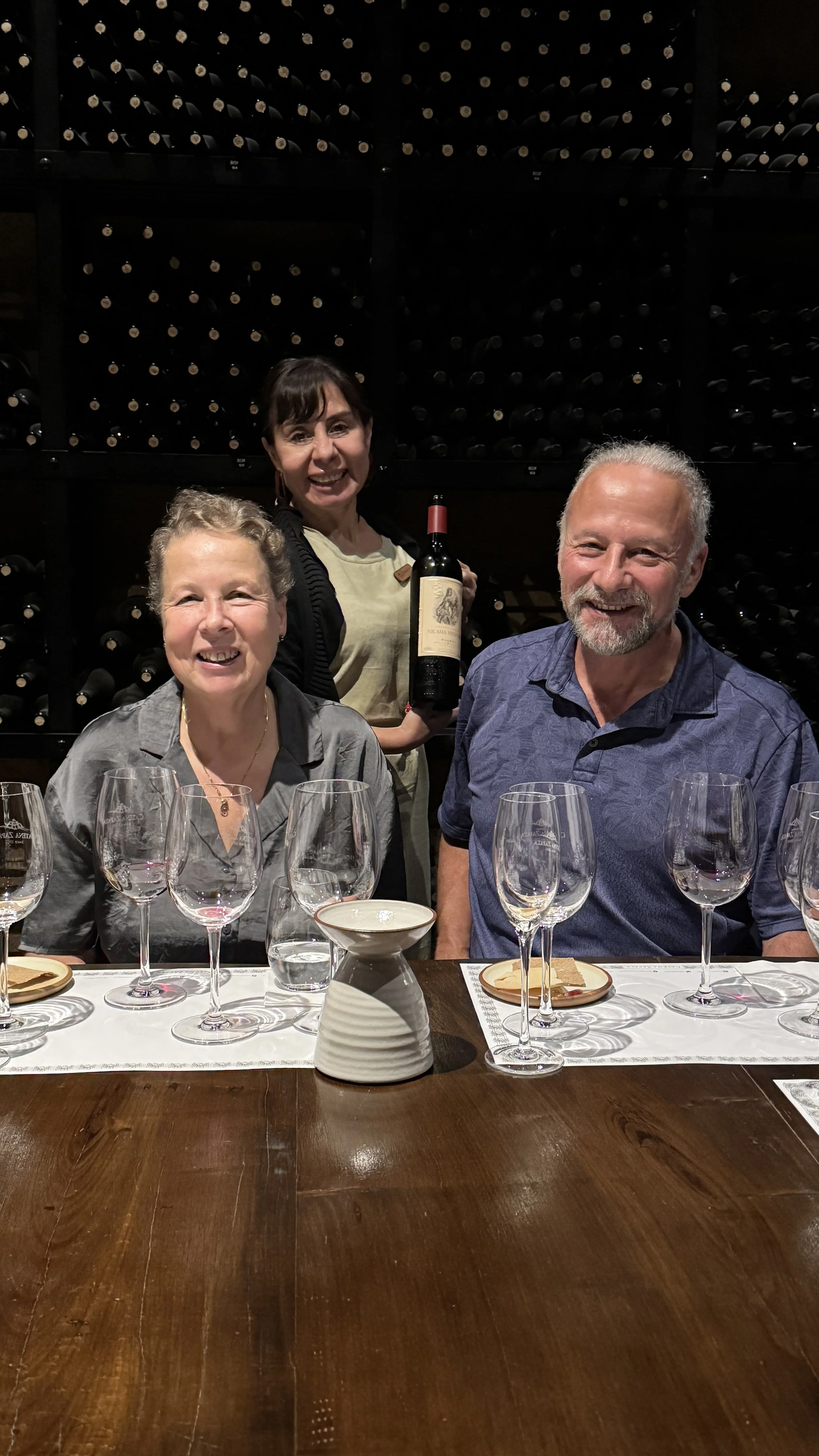
Our wine tasting at Catena Zapata highlighted the way music impacts the flavor and overall experience of drinking wine
The Mendoza region itself is quite flat but sits at a higher altitude next to the Andes. Over time, Pouget discovered that Malbec thrived best in these conditions, and that is how it became the predominant grape of the region. Others grape varietals can be found here as well, especially Cabernet Sauvignon, Cabernet Franc, Merlot, Shiraz and Chardonnay. Although aged wines are supposed to be better, I found through trial and error that I prefer the younger Malbec wines, still tasting like dark fruit, but lighter, smoother and containing less tannins.
In total, we visited five wineries, bodegas, as they’re called here, in the greater Mendoza province, just a tiny sample of the roughly 1,200 wineries in the area. We picked three near us around Luján de Cuyo, and two others farther south in the Uco Valley, the premier wine region of Mendoza.
On our last days, we explored the Argentinian side of the Andes, curious about what to expect. We discovered that this eastern part is a cold high desert, which means it does not receive much precipitation, since the Chilean side of the Andes acts as a climate barrier, holding back the moisture coming from the Pacific Ocean. That also means it is really cold in winter and hot in summer.
Typical landscape
There are no trees, just low bushes, and the rock strata appear as broken-up layers of varying colors, formed when the Andes were created 200 million years ago through the collision of two continental plates. As in the Alps in Europe, there is not just one mountain range but so many, separated by valleys, often containing only a creek or patches of compact green shrubbery. Driving along the highway, we encountered long stretches of bare rock, without villages, streets, or hiking trails, which I found rather unusual. Just nature, seemingly untouched.
Landscape and nature will be our focus for the upcoming weeks: we are excited to finally explore the southern part of South America.