Cape Town - seen from top of the Table Mountain (by Randy)
After our 3 week ocean voyage, of which the final day was the roughest of all sea days, I was really looking forward to be on solid ground when disembarking in Cape Town. Yet – I was still rocking right and left sitting on chairs and lying in bed, and rocking forward and backward when walking and climbing stairs for at least two more days - if not in real life, so then in my mind. Somewhat pleasant, because it is so strange.
We were back in South Africa after more than 20 years – what a pleasure! We loved it the first time around, especially Cape Town, and that part has not changed. We picked places to visit that we did not see before. But one place we definitely wanted to return to: Kirstenbosch Botanical Gardens!
Pincushion Protea
Pink Protea
View from the Botanical Garden to the partially cloud-covered Table Mountain
We were a bit surprised at the botanical garden hardly seeing any flowers in the still lovely and huge grounds; we just found a few of those beautiful Protean blossoms, which are native to South Africa and were always so exotic looking in bouquets during my childhood in Germany. Turns out we are here in their fall soon to be winter, and just like in the Northern Hemisphere, not much is still blossoming at that time.
Bo Kaap is the area of Cape Town where houses are painted colorfully as an expression of their cultural identity
Weather-wise we were very lucky with bright blue-sky sunny days and comfortable and slightly-crisp evenings. Cape Town is even more colorful than we remember and it was easy to fall in love with the city and its inhabitants again. Although we found that housing is more protected with electrical fences and security guards and policemen in the streets than we recall.
Randy finally rode the cable car to the top Table Mountain and he really enjoyed hiking the plateau
View from Table Mountain towards the Cape of Good Hope
I personally prefer to look at Table Mountain on the days when clouds are rolling over the flat top like a table cloth similar to in this photo
One lovely night we met up for dinner with our new found friends from our Antarctic cruise whom we share the same start of getting rid of all furniture and stuff at the beginning of a multi-year long travel itinerary
On a food tour, we learned of the local delicacies of South Africa and daily quick lunch meals and Randy of the taste of ostrich, kudu and springbok. At night there happened to be a jazz festival going on and we tasted a variety of local gins with different botanical flavors in a secret bar, hiding behind a chocolate shop, while listening to live music.
Jazz indoors…
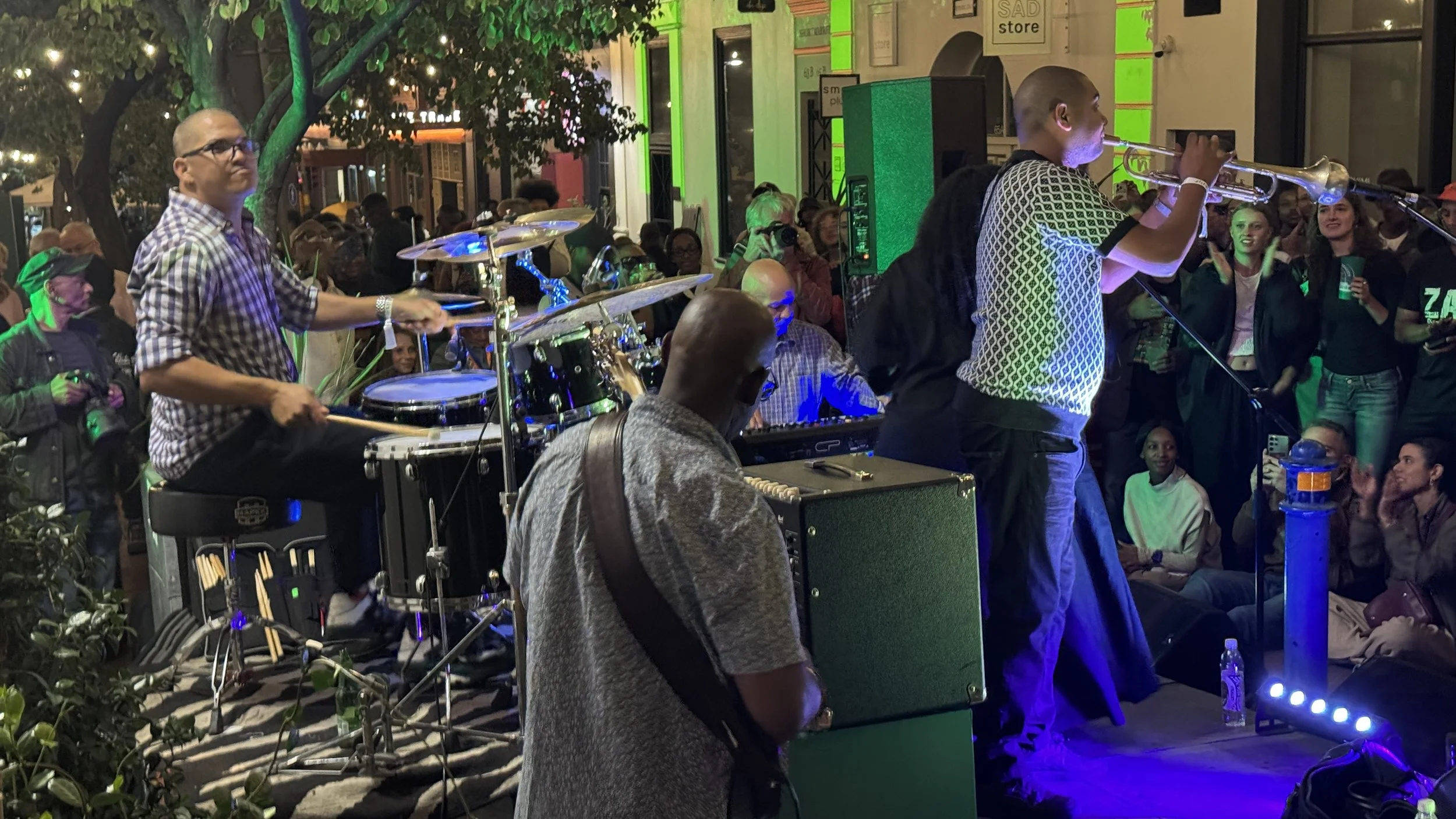
… and jazz outdoors, all over town
We left town to explore a bit of the outskirts around Cape Town with the focus of two wine growing regions new to us, Hermanus and Franschhoek, and also to get a view of another kind of penguin that was still missing from our “penguin discovery list”.
One bay more beautiful than the next along the coast with a magnificent mountain backdrop
The drive along the southern coastline of South Africa was just beautiful, unhurried and comfortable. Randy, by now, is an excellent driver on the left side of the road and this scenic drive was lovely. We stopped at Betty’s Bay to find several hundred African Penguins along a rather long strip of coast, partially protected from humans by a higher boardwalk under which they could waddle without disturbance from their burrows to the ocean’s edge.
With the pink patches of skin above the eyes: definitely African penguins!
To slowly increase the populations of those animals, prefabricated concrete burrows spotted the slopes and seemed to be just as popular for breeding than their natural, dug up ones.
Male Southern Rock Agama Lizard (about 25cm = 10”)
The coastal town of Hermanus and the countryside town of Franschhoek were our destinations for this leg of our trip. Both towns are known to be the center of their own wine region, not too far away from the more famous Stellenbosch that we visited 20 years ago.
Until 1984 the South African government controlled all wine production from one central location. With the political changes occurring at the end of the eighties and into the nineties, farmers for the first time were allowed to import new grape varieties into the country. And they did. Many tried a big variety to figure out which grapes are best suited for the soil to produce the best wines. And of course, it took a long time to select the proper crafted disease-resistant grapes, and years until the plants produced enough grapes for viticulture, and then the experimentation started. Something I love, because I like blends, they often get the best of each grape variety.
Hermanus (at dusk) where you can spot Southern Right Whales off the coast between August and October during their breeding season
We got lucky with our accommodation…
…beautiful and moderately priced…
Last night we had a Syrah - Petite Syrah - Viognier blend (2 reds, one white) which was excellent. One time we had a Cabernet Sauvignon - Merlot - Sangiovese - Pinot Noir - Cabernet Franc blend. That’s a lot of different grapes for one wine – but if the outcome is tasty – why not. Famous for the area is Pinotage, which was created in South Africa in the last century and is a very drinkable, comfortable every day wine, as it is a cross of Pinot Noir and Cinsault (also known in South Africa as Hermitage).
Everyone is wanting Syrah these days, a lot of that is planted, but here it is rather light and does not offer the mouthfeel that we are used to. Chardonnay and Chenin Blanc are the main white grapes, often blended with Roussanne and Grenache Blanc. Franschhoek is famous for their excellent food all over town, and it did not disappoint – and all for such a lower price than we were used to during the last year.
…and we enjoyed a free daily glass of Chenin Blanc from their own vineyards as well!
Small wine production in old oak barrels
These labels are designed to glow under a black light
Love daytime wine tastings!
So thin trunks of the grape vines - although old enough to carry fruit, but not so thick and aged as we are used to seeing in Italy, for example
Those two towns in which we stayed are beautiful on their own, but also gave off a wealthy feel. As a visitor, it felt like stepping into a place of comfort and affluence—cafés, shops, everything clean and inviting. At the same time, I couldn’t help but notice who was privileged and who was working within it. It created a quiet tension that stayed with me.
Just like in the center of Cape Town, everything is nice and clean, and when you leave town and drive a bit outside, you see the surrounding settlements called “Tin Can Villages” or “Blikkiesdorp”, one room cottages made out of corrugated sheet metal and wood. They stretch across the hills in long lines, colorful, not hiding, impossible to ignore, sitting in stark contrast to the nearby towns.
Electricity is hijacked from local street lights and water trucks deliver potable water several days a week
People are extremely friendly, the landscape is again new for us, stunning with mountain ranges close to the ocean, but far enough apart to have beautiful towns and landscapes in between. Our second time in South Africa – and we still loved it. And we haven’t really explored other areas – we hear that the Western Cape is very worth visiting; we haven’t been in any of the “Game Reserves” (doesn’t that sound like a bigger zoo?) or Kruger National Park (as we were on safari in Kenya and Botswana 20 years ago) and we have not seen the furthest east coastline area where our daughter taught high school seniors and college freshmen marine life ecology and scuba diving in crystal clean ocean water ten years ago.
Ka-plush!!!
This is a country we can only recommend to visit – there is something here for everyone, and it is light on your wallet. I envy Heike and Ludwig, a German couple, about our age, that we met while crossing the Southern Atlantic, who are now exploring this beautiful country for three months riding their own, regular bikes – probably the best way to connect to land and people anywhere.
Heike and Ludwig have already traveled all through North and South America on these bikes and are now traveling through Africa towards Europe. In this photo, they have taken their bikes off the cruise ship for a day trip riding on the most remote inhabited island in the South Atlantic, Tristan da Cunha
Side corner shelf in a coffee shop in Hermanus selling board games. *Sigh* We owned three quarters of these games including our favorite, “The Lost Ruins of Arnak”
But after nearly two years on the road, we are feeling the call to be back in Europe by the summer. So, for a little longer, we are continuing to explore.
Southern Double-collared Sunbird, a small nectar-feeding bird endemic to South Africa. The bird is a reminder for us to return to the African continent and explore many more regions and countries - not now, but sometime in the future.