North Patagonia - Land of Lakes
Lago Moreno near Bariloche, Argentina
Santiago, the capital of Chile, was our launchpad rather than a destination. The city felt surprisingly familiar: more Western than Argentina, with spicier, more flavorful food and a noticeable presence of international chains. That might not sound exotic, but after many weeks in Argentina, the comfort of a business hotel and a well‑stocked mall was exactly what we needed.
From Santiago, we flew south to Bariloche, Argentina, to a landscape of lakes and mountains.
The town of Bariloche on Nahuel Huapi Lake in the province of Río Negro has a lot of buildings resembling Alpine styles of Switzerland.
The high mountain environment (1,700 meters) of this area stays free of ice and snow during the summer. The white gray mountain tops are not snow, but exposed rock and sand. The animals and plants must endure strong winds and great extremes of temperature.
We drove Route 40 through the famed Seven Lakes, stopping constantly to photograph glassy water framed by forests and mountain peaks. Each turn revealed another panorama, and when the next lake finally lay too far ahead, we reluctantly turned around, saving our energy for the real adventure, crossing the Andes back into Chile.
Espejo Lake framed by ranges of mountains is the first of the seven lakes on Route 40
We turned back after Lake Korentosas as the next lake was over 30 km further on
Black-faced Ibises are prevalent throughout South America
Our Andean crossing followed a route that has existed for more than a century. Long before buses and boats, travelers made the journey on foot and by donkey, taking weeks to complete what we would do in a few days. Today you can power through in a marathon 14‑hour push involving three buses, four boats, and two border stations, but we chose the more indulgent option of staying at two hotels along the way.
Gitty spotted a red-headed woodpecker!
Our first stop was at the end of the Nahuel Huapi Lake. I followed a path around the lake and up to the Cantaros Waterfall, the sound of rushing water echoing through the trees.
Day‑trippers eventually return to Bariloche, leaving our rustic lakeside hotel in near silence. It felt like we had an entire slice of nature to ourselves. That night Gitty woke to a full moon glowing over the lake, a quiet, almost private spectacle all to herself.
The next stage began with a short bus ride to Lago Frías, where we cleared Argentine customs at a checkpoint built just for this route. The road was private and narrow, used solely by the crossing company’s buses. From the boat crossing, we saw our first truly ice‑capped mountain glacier looming ahead.
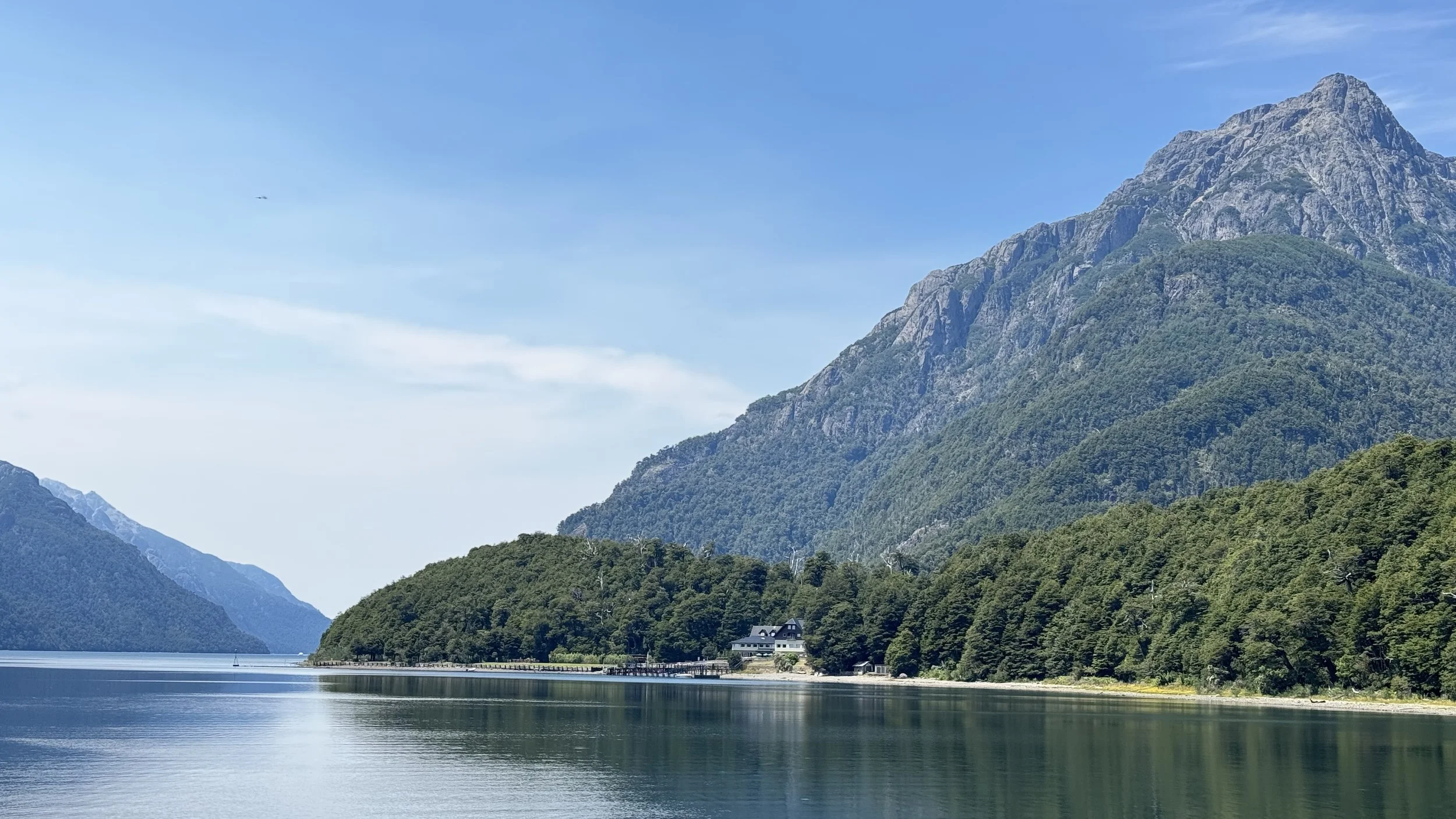
We stayed in an isolated cove in the national park at Puerto Brest, Argentina
I came across this Painted Lizard on my hike around the lake
I enjoyed watching the Ringed Kingfisher drying in the sun
The Ashy-headed Goose is native to Argentina
Ice-capped Mount Tronador from the Chilean side
Back on a bus, we rattled over rough Andean terrain, stopping several times at viewpoints. We admired Monte Tronador, the tallest mountain in the area, and paused at a pristine waterfall with icy, drinkable water. It was a reminder that this was still a wild, remote crossing, despite the well‑oiled operation behind it.
On arrival in Peulla, we entered Chile through a careful customs process that included a manual inspection of every bag. Chile is serious about protecting its ecosystems, and they are zealous about preventing fruit or other food products from entering the country. This makes crossing the border into Chile slower than entering Argentina.
It rained a bit but soon cleared up for a wonderful ride
Staying overnight in Peulla, we met a lovely couple from California with a similar outlook on life, and conversation flowed easily over dinner and Carmenère, Chile’s signature grape for wine-making. We were enjoying the Carmenère more than the Argentine Malbec.
The next morning, I saddled up. On horseback, I rode to the lake we would be soon be crossing, letting the horse do the work while I soaked in the landscape. It’s one of the reasons I love horseback riding: I reach places I’d never hike to on my own.
Because each leg of the route picks up exactly where we left off the previous day, we had until afternoon to enjoy Peulla, a popular getaway for many people staying in Puerto Varas. Our final stretch involved a two‑hour boat ride across Todos los Santos Lake, passing the famous Volcano Osorno towering over the shoreline, an iconic image of southern Chile.
Osorno Volcano viewed from Puerto Varas over Lake Llanquihue
Chiloé, a large island on the Pacific side of South America, holds an outsized place in Chile’s imagination, so we were determined to discover why.
Our introduction to Chiloé’s food came in Ancud, where we stopped for lunch. I ordered Curanto, a local specialty, and it was memorable in every way. Curanto is a feast: lamb, sausage, mussels, and clams cooked over heated stones and covered to trap the steam. The result is smoky, rich, and deeply comforting, with a broth so flavorful I couldn’t get enough of it. The portion was enormous, but I refused to abandon a single plump mussel or clam.
Curanto is a specialty of Chiloè Island
Huge clam and mussel farms in Canal Dalcahue
Chiloé’s cultural treasures are as satisfying as its cuisine. Spread across the island are 16 wooden churches built in the 1800s, which have been recognized as a UNESCO World Heritage Site. Their brightly painted facades catch the eye, but it’s the carpentry inside that truly impresses—arching beams, polished wood, and a sense of skilled craftsmanship that doesn’t fail to impress.
Church of San Francisco in Castro
The neo-gothic wooden interior immediately catches the eye
Castro is famous for yet another striking architectural feature: houses built on stilts along the water’s edge. Known locally as palafitos, these homes once sprang up where the land was cheap or free, hugging the shoreline on long wooden legs. At low tide, their foundations are exposed.
Instead of staying in the city itself, we chose a hotel outside Castro, more immersed in the surrounding nature. From our room we could see the sound, and trails crisscrossed the property down to the water. It felt peaceful and grounded, like being guests in a quiet corner of the countryside rather than a busy town, and we were sorry not to stay there longer.
The next day revolved around wildlife. We had booked a boat tour to see a colony of penguins, but first we squeezed in a few more wooden churches, each with its own personality and color scheme.
Somehow we misjudged the time to drive to Puñihuil and pulled into the beach parking with only minutes to spare. Fortunately, that was enough. After we donned life vests, we headed toward the water to figure out how to board the 40-person skiff without soaking our shoes. The answer: a wheeled platform that carried about fifteen people at a time. Staff pulled it into the water where we climbed aboard the boat. I had never seen this process before and was delightfully surprised.
The immensity of the forest was breathtaking
The tour was in Spanish, so we caught only fragments of the commentary, but the experience was still fun. We motored to several small islands, spotting two different species, Humboldt and Magellanic penguins, as well as endemic cormorants and ducks. The weather cooperated completely, a blue sky and the scent of the sea on the Patagonian wind. We sympathized with these poor penguins hopping around on the rocky islets while boats disrupted their peace.
After the tour, we continued driving along the coast to Caulín Bay, a quiet cove designated as a habitat zone and a birding hotspot. Time slipped away as we scanned the shoreline for Chiimangos, Whimbrels, Terns, Sandpipers, and Snipes, walking along the beach and relocating to several vantage points. Eventually, the road curved inland, and the coastline we’d been following disappeared. The drive back to the ferry passed quickly, and soon we were crossing again to the mainland, bound for Puerto Varas.
Black Skimmer
Whimbrel
Chile’s Lake District isn’t just a stop between big-name destinations; it’s a place well worth visiting. As we drove away from the lakes and volcanoes, I contemplated how the area impacted us—not in dramatic moments, but through a series of quieter experiences: a moonlit lake, a wooden church, a plate piled high with smoked seafood, the shuffle of penguins, a habitat of exotic birds. I wondered what further adventures awaited us in Patagonia.