Patagonian Ice Fields
As we headed farther south into Southern Patagonia, the landscape opened up. The Andes softened into vast expanses of rolling hills dotted with scrub and wild guanacos, some loping in packs, with a few loners banished from the group by the alpha male. In this area, the border between Chile and Argentina twists with the highest peaks of the Andes mountains.
Endless expanses right and left
Guanacos
The Perito Moreno Glacier near El Calafate is the most famous of all Argentinian glaciers. We arrived on a warm, sunny afternoon which was our luck and immediately heard the deep, thunderous booms of ice cracking and crashing into the turquoise water.
Imagine the size of the cliff wall these icebergs calved from!
What sets this glacier apart from many in Europe is that it extends into the water, a massive sheet of ice with the front wall rising 240 feet above the surface of Lake Argentino. We took a boat ride along the north face watching huge blocks of ice tumble into the lake shooting plumes of water skyward. The scale of Patagonia plays tricks on the eyes, everything looks smaller than it is until you get close, and on the boat, my eyes popped with the immensity of the jagged, icy cliff.
The Perito Moreno glacier has almost 100 square miles of surface area
The front wall is over 3 miles wide
The condensed bubbles of air in glacier ice don’t necessarily add much flavor to the 12 year old scotch, but it’s still pretty cool to savor
I found a spot along the southern wall boardwalk watching for more glacial activity. Just as I arrived, an iceberg rolled over, this giant block of ice turning upside down in slow motion.
I watched, mesmerized, the ice shift, shear and tumble into the lake for an hour. When I finally tore myself away and headed back up the path, a loud boom echoed behind me, Perito Moreno putting on another show, just out of my sight.
Glacier ice is compacted to the point that there’s less than 20% of air remaining contributing greatly to its iconic blue hue. One thinks of glacial change as slow, but that’s far from true as this glacier moves at 6.5 feet per day contributing to its plethora of icebergs in Lake Argentino.
The iceberg that flipped over was huge compared to the others
Here it is flipped, taken from a slightly different angle
The next day promised another adventure: the Upsala Glacier and a visit to Estancia Cristina, a rather modest ranch at only 50,000 acres with some estancias almost 5 times larger. Ranches spread across the plains, home to sheep, cattle, and horses, although Estancia Cristina is now mostly a museum of how a sheep ranching operated until the mid 1960s.
We were navigating through the northern arm of Glaciers National Park over calm water and crisp air. In 2013, a rockfall had sent a tsunami surging along the Upsala Fjord, so boats are now forbidden to approach the ice cliff closer than 24 kilometers. Even from that distance, with a height of a twenty-story building and extending 50 km into the distance, the ice cliff offered yet another spectacle.
White bands are prevalent on the top side of the wings
We got lucky finally spotting a South American Condor perched on a cliff, its massive white-striped wings extended wide. The condor is the largest flying bird in South America and one of the largest in the world and we were excited to finally spot one.
Later, as we reached a glacier lookout via 4x4 over a bumpy road, we watched as a whole family of condors spiraled above probably training their young in flight. The spectacle was unique and we were incredibly lucky to observe it.
Patagonian distances are misleading because of the vastness of the area
This glacier has greatly receded over the past century based on survey photos taken in the 1940s, having reached their recent maximum extent during the Little Ice Age which ended in the mid-1800s. Many glaciers in South America have been naturally retreating ever since, a process only now exacerbated by climate change.
The Upsala glacier has receded 12 miles over the past century otherwise we would be standing on it
We spotted many mollusk shells high in the mountains trapped in stone
If you wondered what a mylodon looked like, it wore a blue raincoat and woolen cap and roamed South America a million years ago
We caught the 8 a.m. bus out of El Calafate, bound for Puerto Natales, a well-established traveler’s route hopping across borders in southern Patagonia. The six hour bus ride wasn’t terrible until we got to Chile. We had to take our backpacks off the bus, shuffle into a long line, and brace against the biting Patagonia wind whipping at us mercilessly as our luggage was removed from the hold to be inspected by sniffer dogs seeking forbidden fruit. I believe I mentioned in a previous blog how diligent Chile customs is about bringing produce into their country, unlike the shrug encountered entering Argentina.
Close to Puerto Natales, we encountered the Mylodon Cave where the remains of a previously unknown species, a massive ground sloth standing 3 meters tall and weighing a ton, was discovered in late 1800s by a German settler named Hermann Eberhard. The remains were in such pristine condition that locals were convinced the creatures were still living. Eberhard kept bits of the mylodon’s hide as curiosities, selling snippets to intrepid travelers before scientists realized the significance of his find at which time very little of the hide remained.
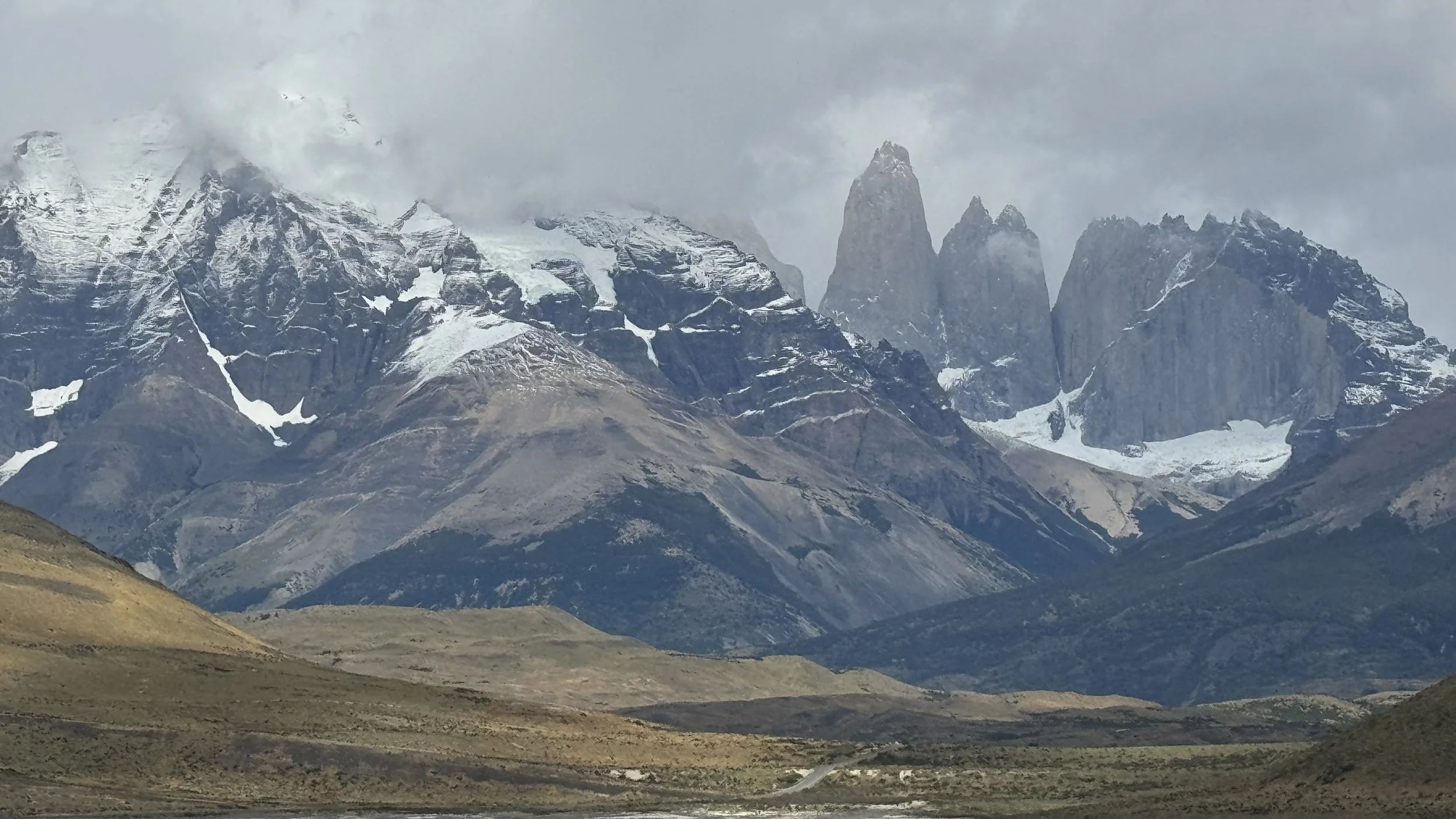
The majestic Paine Massif, centerpiece of Torres del Paine National Park. The word Paine comes from the Aonikenk language of the Tehuelche people, it means blue, inspired by the color the granite peaks appear from a distance. The massif, a geological feature forming when plates collide, rises like a fortress above the steppe, and the three spires, the famous Torres (towers), dominate the landscape.
An absolutely unique restaurant that we just absolutely loved
Puerto Natales itself is compact and small, yet we still stumbled across an amazing restaurant built in stacked shipping containers for dinner with the kitchen on the second floor. We were so impressed with the food that we returned the next day for lunch.
Having seen Perito Moreno already, we were told the Chilean glaciers were not as impressive, so used the time in the city to catch up on some urban sketching instead.
We loved watching this park outside our window which was full of activity during the day with dogs chasing skateboarders up the slopes and bikers twirling in the air
Melting glacier ice creates turquoise lake waters
One more bus ride of only three hours brought us closer to the end of the world and into the city of Punta Arenas. We started off the next morning to an absolute amazing trip! By 6am, we were sailing with about 16 other people to two small islands in the Strait of Magellan, the waterway that connects the Atlantic with the Pacific Ocean, with the continent of South America on the top and Tierra del Fuego to the south. Isla Magdalena is home to about 40,000 Magellanic Penguins every year, one of the largest colonies in South America. On the rather barren island is just a lighthouse and a ranger station. Other than that, it is full of birds. We landed on the island and walked along a roped-off path that was 3 feet high, so that the penguins could walk below it without any disturbance, whereas we followed the loop for about one hour.
The young, having waterproof feathers, have all started swimming
The penguins, which are about 70 cm high, crossed right in front of us, not more than three meters away. They sat in front of their borrow hole, chatted with the neighbor or gathered in small groups. We had come at a time when we still could see some fluffy chicks sitting next to their parents, but most youngsters had already become juveniles and were in the ocean enjoying their new found life. So, on the island were now only a few late chicks left and all the others were adults who were in the state of molting, a process that takes about three weeks. Scattered amongst the penguins were Kelp Seagulls and the otherwise pelagic Skua breeding with their youngsters asking their parents quite noisily for food.
On another corner of island we saw a big group, further away, which we believed were penguins, yet it turned out that to be a huge colony of big southern American black and white Imperial Cormorants.
Antarctic terns, Dolphin Gulls, many ducks and geese called the island their temporary home as well, and did not move away when we passed close by. In about a month, the island will be deserted until next November/December when it will fill up with all these animals again. It was such a fantastic feeling to be allowed so close to the beautiful Magellanic Penguins!!!
Our boat took us to a nearby rock island, Isla Marta, to observe a colony of majestic sea lions. Several adult huge male sea lions were surrounded by many smaller brown furred female sea lions and even more very agile black pups, diving in and out of the water and hopping on land, and then jumping in the ocean again. The brown fir is just a sign, that that animal has not been in the water for a while. By noon, we were back in Puntas Arenas and felt real lucky to have been able to enjoy these animals so close in their home environment. Fortunately, these trips to the island are highly restricted for us humans, and we got really lucky!
The massive sea lion in the upper left back is the alpha male
A few days later we boarded a huge ferry that would take us across the Strait of Magellan in over a two hours saving us from a very long driving day. Once back on land, we still drove along the coast on a dirt road another few hours pausing to take in the sweeping views along the way heading to the only place in South America wherea colony of King Penguins have settled. The Reserve is privately managed to protect the fragile colony, no feeding, touching, or tagging them. Limited groups of visitors can observe but not interact with the penguins.
King Penguins
There were perhaps sixty to a hundred birds on a bluff across a river, some tending to their chicks, others resting flat on the ground, and one at the water’s edge starting to molt. During molting they are no longer waterproof. They can’t swim or fish, leaving them vulnerable to the cold, so they must bulk up beforehand to survive the process.
Palacio José Montes located in Punta Arenas, Chile, a hidden gem of a town
We spent an hour quietly watching the colony, the second‑largest penguin species in the world, utterly mesmerized. Time slipped by quickly, and before long we were heading back toward the car for the long journey home. The drive back took four hours as we needed to circumnavigate to another ferry to cross back over the Strait of Magellan at its narrowest point. A completely different experience from Magdalena Island and a long day of travel, but totally worth it to witness these penguins so closely.
We dallied in El Calafate, Puerto Natales, and Punta Arenas longer than most travelers and got to know those cities a little better. Although they each held their own intimate charms, we were very impressed with Punta Arenas. If ever there was a need to hide out from the world, this city was added to our top ten locations worth considering.
Typical roof style of the area - from long time ago, now preserved for today
In Patagonia, every horizon promises something wilder just around the bend and that’s the beauty of forging farther south, the places get emptier, the travelers heartier, and the moments feel sharper. You encounter people with a similar perspective on life.